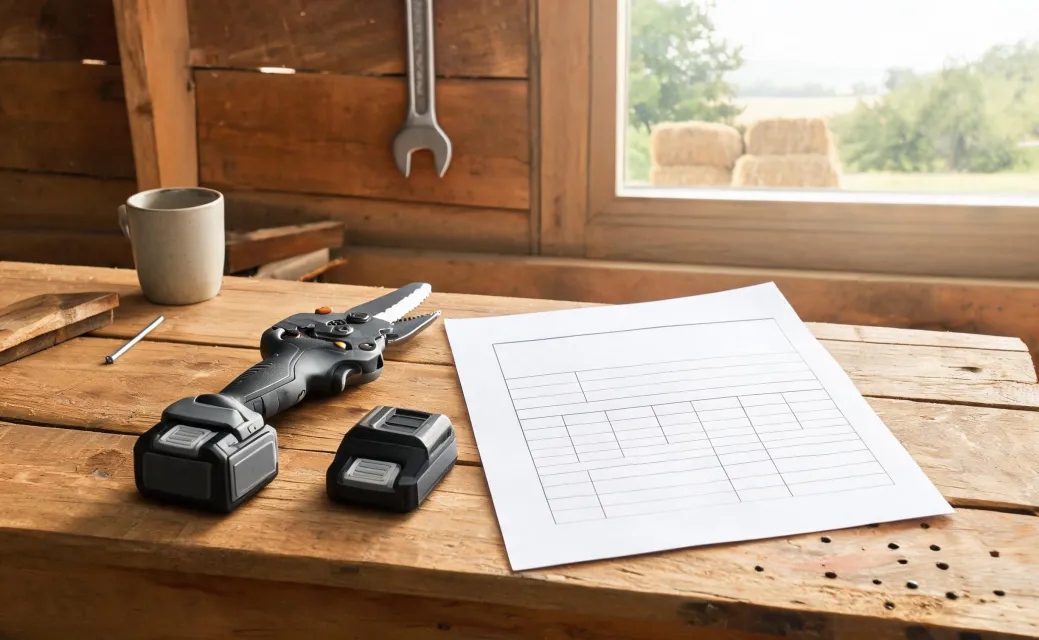
The most useful number on the Milwaukee 2534-20 is not a motor figure. It is 1-1/4 inches, and it sits in the operator manual as the diameter of trees, bushes and plant branches the shears are intended to cut. That sentence is a ceiling written by the people who built the tool, and it moves the purchase question away from how strong the shear feels and onto something you can answer in the row: does the wood I actually cut sit under that line?
The same manual draws a second line that gets far less attention: wood only, and no sheet metal, plastics, masonry or non-wood building materials. Two limits, one page. For this model they decide more about fit than battery platform or blade length ever will, and everything below stays inside this one model, the 2534-20, because those limits belong to its manual rather than to every electric shear on the market.
The 1-1/4-Inch Line That Decides the Tool
Notice what the manual does not describe. There is no jaw opening in inches, no cutting force, no claim about what the shear can be pushed to. What it describes is intended use: trees, bushes and plant branches 1-1/4 inch or less in diameter. That is the manufacturer's own statement of what this specific tool is for, and it does not travel to a different shear with a different manual.
So which question is a buyer actually answering when they argue about motors and batteries? A tool that never touches wood above the stated diameter has no trouble being strong enough for the work in front of it, and a tool asked to chew through wood beyond the stated diameter has no motor setting that makes the job its intended use. The number is the boundary. Blade length and battery capacity do not move it, and no specification on the box overrides it.
The practical version of that: measure the diameter of the wood you cut for most of a shift, not the biggest limb on the property. Most buyers do it backwards, size the tool against one stubborn old tree, then discover the daily work is well inside the line and the outlier is a saw job either way.
Walk One Cut Before You Squeeze the Trigger
One pass with the 2534-20 looks like this. You pick the branch and look at it before the blade does anything: is this wood, and does it measure within the diameter the manual names for this model? Only after both answers are yes does the tool belong on it. The manual carries its own warning for that moment, that the blade is sharp and that hands must be kept away from all cutting edges and moving parts. Then you make one cut and let the blade come to rest, and you start over on the next branch instead of carrying the trigger down the row on autopilot.
That reset step reads like wasted motion until you watch how position drifts once cuts run together. Hands creep toward the head to steady a branch, a second stem gets swept into the jaw, and the next cut is made before anyone has checked what is in it. One branch, one check, one cut. The pause costs a moment; the alternative costs you the habit of looking.
Only Wood Counts, and That Changes the Job
The material rule is written as flatly as a manual can write it. Cut only materials made from wood. Do not cut sheet metal, plastics, masonry, and non-wood building materials. Read the list again, because it covers things that live inside a real orchard and vineyard: tie tape, irrigation line, fence wire that has grown into a trunk.
Here is the tradeoff stated plainly rather than softened into a caution. If the work in front of you includes plastic ties, irrigation tube or wire grown into a branch, this shear is the wrong purchase for that work. The rule is a material rule, and it disqualifies the job before the blade reaches it. What keeps that verdict fair is the condition attached to it: on wood inside the stated diameter, the tool is doing exactly what its manual says it is for, and that is the whole of its job.
Where this separates from a lot of what sits on the same dealer shelf is the mental model, not the price tag. Many cutters are sold as general-purpose problem solvers, the thing you grab for a tangle of stem, string and wire. This model's manual breaks that picture on purpose. The ban belongs to the 2534-20 and its documentation; it is not a statement about every electric pruning shear, and you should read the manual of whichever model you are actually holding.
Three Jobs Where This Tool Is the Wrong Pick
Suppose a grower walks up to a dry limb that measures just past the stated diameter and squeezes anyway. Nothing dramatic happens, which is the problem. The decision that mattered was measurement, taken a few seconds earlier, and it pointed at a saw. Imagine the second job: a plastic tie is looped around the branch at the exact height the blade will pass. Here the blade is irrelevant; the material rule disqualifies the cut before the trigger is pressed, and the fix is a pair of hand snips.
Consider the third, which catches people who already know the first two. A length of fence wire has grown diagonally into a branch, buried at the point where the cut would land. Same rule as the tie, different failure point, and it is caught before the cut rather than after, by looking down the length of the branch instead of only at the diameter. None of these are exotic cases. They are the ordinary clutter of a working block, and each one is decided by a check rather than by how the shear performs.
Why the Tool Gets Blamed for a Bad Cut
When a cut inside the tool's own limits still goes badly, the story told afterward is usually about power. The shear was weak, the battery was tired, the blade was dull. Ask a narrower question instead. Is the branch wood? If yes, is it within the diameter this model's manual names? Assume it is, and ask whether hands and branch were positioned so the blade met only the branch, with nothing else in the path. And if all of that holds, ask whether the tool was being asked to do something its manual says it should not do at all.
Follow that chain to the end and the root is scope, not muscle. A tool used outside its stated diameter or on the wrong material gives the owner a bad afternoon, and the owner credits the experience to the machine. This is why a single page of the manual outranks a spec sheet during a purchase: the spec sheet tells you what the tool has, the manual tells you what the tool is for, and only the second one predicts whether your block is a fit.
The One Check Before You Buy or Start
Before you pay, and again before you squeeze the trigger on the first branch of the day, open the manual for the exact model in your hand and confirm two lines in it: the branch diameter it states and the material rule it states. On the 2534-20 those read 1-1/4 inch and wood only. Then walk your own ground and compare the wood you cut most often against that number, and the clutter in the cut path against that list.
That check outranks the rest of the spec sheet for one reason: it is the only line that tells you whether the tool belongs in your job at all, while the others only adjust how the job feels once it does. What is available here does not include an independent comparison test, a price, or a measured output figure, so nothing in this article can stand in for that page. Confirm the two lines for the model you are buying, and let your own branches answer the rest.
