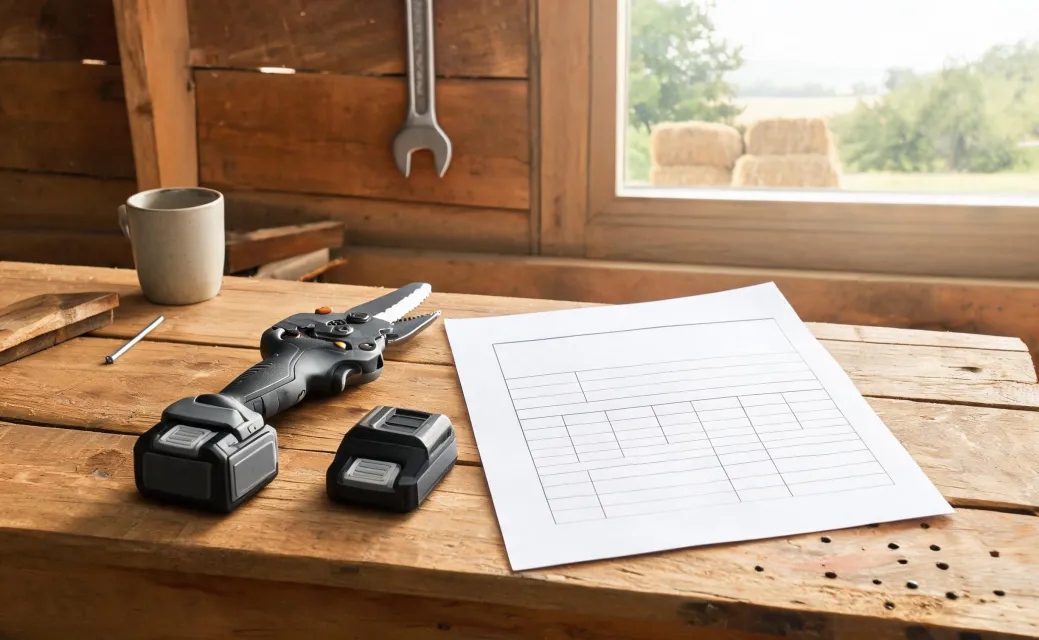
The shear on my bench is a Milwaukee M12 2534-20 with its blades closed and its battery pack off the tool, and I am cycling the blade by hand while the grower who brought it in watches. He pulled it out of a cherry block because of a sound he could not place. It still cuts clean. That sentence — it still cuts — is the one I hear most often with a shear in front of me, and on this model it settles nothing.
Scope first: one model, the Milwaukee 2534-20, and one document, that model's operator manual. Nothing below transfers to another Milwaukee model or another brand without reading its own manual. The claim is narrow: a clean cut is no evidence that the tool is in good repair. What decides the question is whether the conditions the manual tells an operator to inspect for are present.
Why a Shear That Still Cuts Fails Inspection
Cutting is one output, measured under one condition. Put a branch in the jaw, the blade closes, the branch drops, and the shear has passed a test that says almost nothing about the parts doing the work. A moving part can drag through part of its stroke, a gear can whine at a pitch it did not have last season, a housing can flex on a crack nobody has seen yet. None of that changes the cut until the blade stalls halfway down a row, and by then the decision has been made for you.
The manual asks for something different from a cut check. It asks the operator to keep the tool, battery pack and charger in good repair through a regular maintenance program, and to inspect for undue noise, misalignment or binding of moving parts, breakage of parts, or any other condition that may affect operation. Every item on that list is a condition, not a score. A shear that cuts is answering a question the list never asked.
So the working rule at my bench: cutting performance does not substitute for inspection findings. Testing only the cut confirms the one thing you can see and says nothing about the conditions the manual asks you to check.
What the 2534-20 Manual Tells You to Look For
Four entries, in the manual's own words. Undue noise means sound beyond whatever the tool normally makes under load — a grind, a rattle, a whine that arrives with a specific part of the stroke. Misalignment means parts out of line with each other; a blade that closes off-center is the obvious case. Binding means a moving part dragging or sticking instead of travelling freely, and it is the one that hides best, because a slightly binding blade still cuts thin wood all afternoon. Breakage covers cracks, chips and missing material. The fourth entry is a catch-all: any other condition that may affect the tool operation, which tells you the list is a floor, not a ceiling.
Tool state during inspection is specified too. Always close the blades and remove the battery pack any time the tool is not in use. An inspection is a not-in-use moment, so that is the configuration you check it in: blades closed, pack off the tool.
How I Would Run a Bench Inspection
Suppose I set up the check for this grower's shear this afternoon. One sheet of paper, four rows copied from the manual's categories, three marks per row: present, absent, unclear. I cycle the blade slowly and note where in the stroke any noise appears. I sight down the blade line with the jaws closed to see whether the edges meet squarely. I run a thumb along the housing seams for cracks and check the fasteners I can reach without opening anything. No numeric scale, because the manual supplies no threshold, and a made-up pass mark would be worse than no sheet at all.
The result I would write down is a set of conditions, not a verdict. Suppose two rows come back unclear — a faint tick I cannot place, a blade line that looks close but not quite true. An unclear row keeps the service question open. A sheet with three clean absences and one unclear entry is more useful than a confident memory of it seeming fine, because the next person to look at the tool, whether that is a service tech or me in three weeks, can see exactly which condition I could not resolve.
Noise Versus Binding on a 2534-20
Both findings sit on the same list, and the manual ranks neither. If I have to say where my attention goes first, I would rather chase a bind, a misaligned blade line or a cracked part than a noise, because those three are mechanical facts I can point at on the bench, and noise has to be characterized before it means anything. That preference is about where I spend the hour, not permission to keep cutting with a noisy shear. Any listed condition keeps the tool in the service track; the list has no severity tiers to argue down from.
What actually matters is the comparison against the cut. A clean cut is weaker evidence than a bind, because the cut samples one condition while binding, misalignment and breakage are the conditions the manual names. Two shears can both take a branch cleanly and be in very different shape — one with a true blade line, the other binding through the last part of its travel. I cannot tell them apart from the branch on the ground, and neither can the person who buys the tool from you.
When the Inspection Turns Into a Service Trip
Routing is explicit. For repairs, return the tool, battery pack and charger to the nearest authorized service center. Three items, and it is easy to hand over the shear alone. That wording treats the set as one maintained system, so the pack and charger travel with the tool instead of staying in the truck.
Once the inspection finds a listed condition, the next step is authorized service, not a bench adjustment. The manual gives the operator an inspection list and a destination, and no field-repair procedure for a bind, a misaligned part or a break. A grower who opens the housing to chase a tick has left the documented route for an undocumented one, and the tool is now in a state nobody has instructions for.
What My Inspection Cannot Prove
The sheet records the manual's conditions and nothing else. It does not tell you whether the blade is as sharp as it was in spring, whether the battery pack still holds its original capacity, what the repair will cost, how long it will take, or how often this fault shows up in this model across a season. Those are separate questions with separate evidence, and none of the four rows answers them.
What would flip the call? Two things only. If the current manual for this exact model no longer listed those inspection conditions, the sheet would lose its basis. If it no longer directed repairs to an authorized service center, the routing would change. A different model, a different brand, or a newer version of this tool sits outside what I can say here, and each one needs its own manual read before the same rule applies.
Back at my bench, the grower gets one of two outcomes. If any listed condition is present, the shear goes into its case with the battery pack and the charger, and the case goes to the nearest authorized service center. If all four rows come back absent, he leaves with a dated sheet in the folder and one note to himself: look again the first time the sound changes. Neither outcome certifies the tool as fine — one is a service route, the other is a record.
